
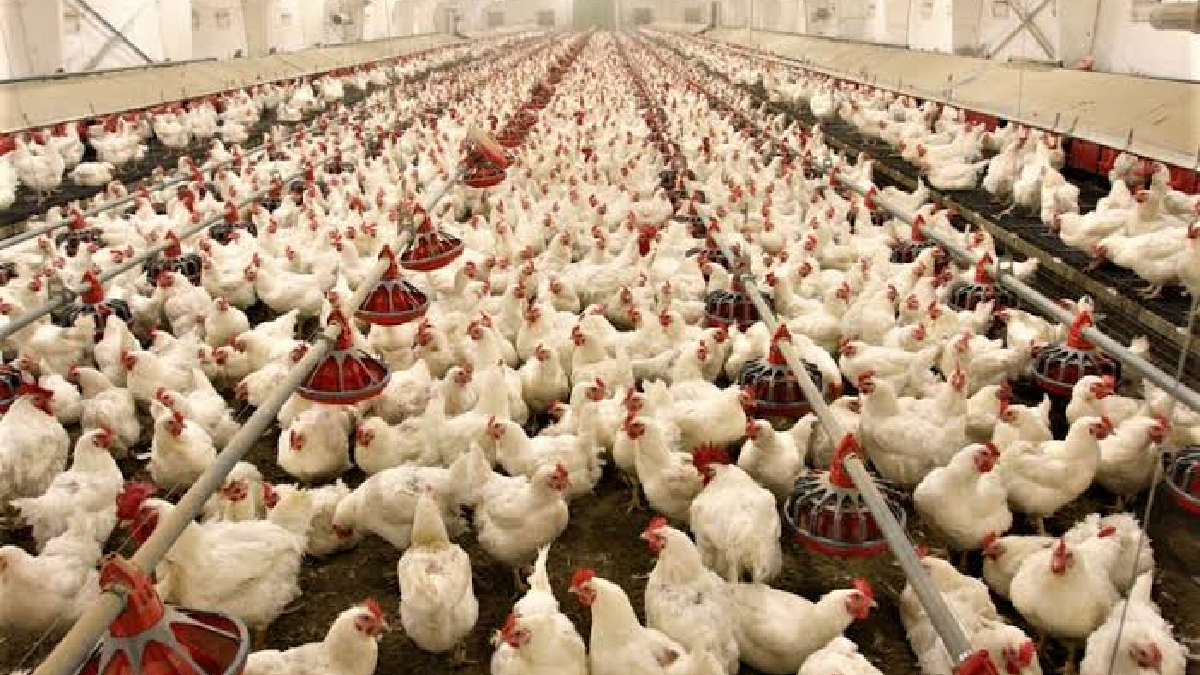
Researchers have detected six heavy metals in chicken and egg samples collected from poultry farms in Cameroon, raising questions about food safety controls in a sector that produces tens of thousands of tons of poultry products each year. The findings, however, come from a limited sample and do not establish how widespread contamination may be.
Lead, nickel, arsenic, cadmium, chromium and mercury were detected in broiler chickens and eggs sampled in Cameroon’s Center, Littoral and West regions, which rank among the country’s main poultry-producing areas. The results were published on September 1, 2026, in a study conducted by researchers from the University of Yaoundé I and the Institute of Medical Research and Medicinal Plants Studies, led by Fabrice De Paul Tatfo Keutchatang.
Researchers collected 48 chickens and 180 eggs from 12 farms, with four farms selected in each region. The chemical analyses, however, covered only 18 composite samples: six muscle samples, six liver samples and six egg samples.
The methodology establishes the presence of heavy metals in the samples analyzed. It does not determine the proportion of farms or poultry products affected across the three regions, much less across Cameroon as a whole.
Mercury Concentrations Highest in Chicken Livers
The highest concentrations involved mercury in chicken livers, where levels ranged from 798.3 to 845.5 micrograms per kilogram. Concentrations were far lower in muscle tissue, at between 1.4 and 2.3 µg/kg, and in eggs, at between 3.3 and 3.6 µg/kg.
Chromium concentrations reached 53.7 to 60.4 µg/kg in muscle tissue, compared with 13.7 to 15 µg/kg in livers. For cadmium, researchers measured concentrations of 27.3 to 29.6 µg/kg in muscles, 2.6 to 3.9 µg/kg in livers and 9.2 to 9.9 µg/kg in eggs.
Compared with the maximum values used by the study’s authors, some concentrations were substantially higher. Cadmium in muscle tissue reached as much as 2.96 times the selected threshold, chromium as much as 30.2 times the reference level, and mercury in livers as much as 281.8 times the value used by the researchers. In eggs, mercury concentrations exceeded the study’s 3 µg/kg reference value by 10% to 20%.
Those exceedances, however, cannot automatically be treated as violations of Cameroonian standards. The study does not clearly identify the regulatory origin of several of the thresholds it uses.
For comparison, European Union regulations set a maximum cadmium concentration of 50 µg/kg for poultry meat, compared with the 10 µg/kg reference value used by the researchers. Under that European benchmark, the concentrations measured in muscle tissue in the Cameroon study would remain below the limit.
Cameroonian standard NC 45:2001-20 covers food contaminants, but the detailed limits applicable to poultry products are not available in the public catalog of the country’s Standards and Quality Agency.
A Control Issue for a Mass-Market Industry
The size of Cameroon’s poultry market nevertheless gives the study’s findings broader economic significance. According to the Livestock Ministry’s 2023 statistical report, Cameroon produced 65,000 tons of poultry meat and 123,000 tons of table eggs that year.
If the findings were confirmed through a representative sample, the implications would extend beyond food safety. They could affect controls on animal feed, monitoring of water and soil, laboratory testing capacity, farm traceability and, ultimately, consumer confidence.
The study, however, provides no basis for estimating the volume of poultry products that could be affected, potential economic losses or the cost of bringing production into compliance.
An earlier study by the same research team, based on 15 poultry-feed samples collected in 2019, detected lead concentrations of up to 995.8 µg/kg and arsenic concentrations of up to 2,819.4 µg/kg.
Those findings make poultry feed one area that warrants further checks, but they do not demonstrate that feed caused the presence of metals detected in the new study. The two studies also did not necessarily examine the same farms.
Several Calculations Require Further Scrutiny
The health-risk assessment presented in the study also contains several points that warrant verification before its findings can be generalized.
To estimate exposure from chicken consumption, the researchers calculated an average of the concentrations found in muscle and liver tissue. That method gives equal weight to both tissues without distinguishing how much of each people actually consume. For mercury, the particularly high concentration found in livers therefore pushes the resulting average sharply higher.
The risk-assessment table also contains a discrepancy in some nickel figures. A concentration of 0.4 µg/kg reported in the analytical results appears as 4 µg/kg in the exposure calculations.
The study also states that eggs remain below recommended limits, even though its own table shows mercury concentrations above the 3 µg/kg reference value used by the authors.
Finally, the analyses measure total chromium and do not distinguish between trivalent chromium and hexavalent chromium, which has much greater toxicity. The European Food Safety Authority has stressed the importance of that distinction for an accurate assessment of food-related chromium risks.
The study therefore establishes the presence of several heavy metals in the samples tested and provides grounds for additional checks on poultry farms, animal feed, water and the surrounding environment. Its sample size and methodological limitations, however, do not support a conclusion that Cameroon’s poultry production is broadly contaminated or establish what share of products would exceed applicable standards.
Source: businessincameroon.com

